Image Transformation Study
Image Transformation Study
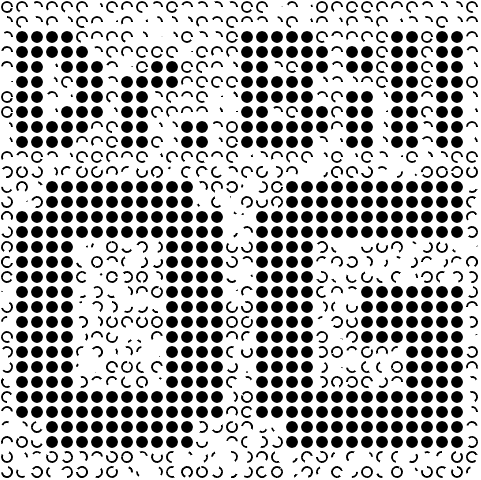
This was a proof of concept drawing of an algorithm I created for changing one image into another where I stored all the line segments that make up an image (in this case a set of vertical and horizontal lines) into two arrays. Think of it as of two bags of line segments.
Then, over the course of some number of frames (numFrames) I juxtapose one image on the other. For one frame I build one image, randomly picking out a percentage of the line segments (1/ numFrames). Then I overdraw the second image, complete at first by in subsequent frames subtracting some number of line segments.
For example, for an 11-frame sequence: First frame 100% of image one, 0% image 2. Second frame 90% of image 1, 10% of image 2. Third frame 80% of image 1, 20% of image 2. Until frame 11, 0% of image one, 100% image 2.
I used this algorithm as the basis for my work entitled: That Walleye Has Got a Lotta Gull.
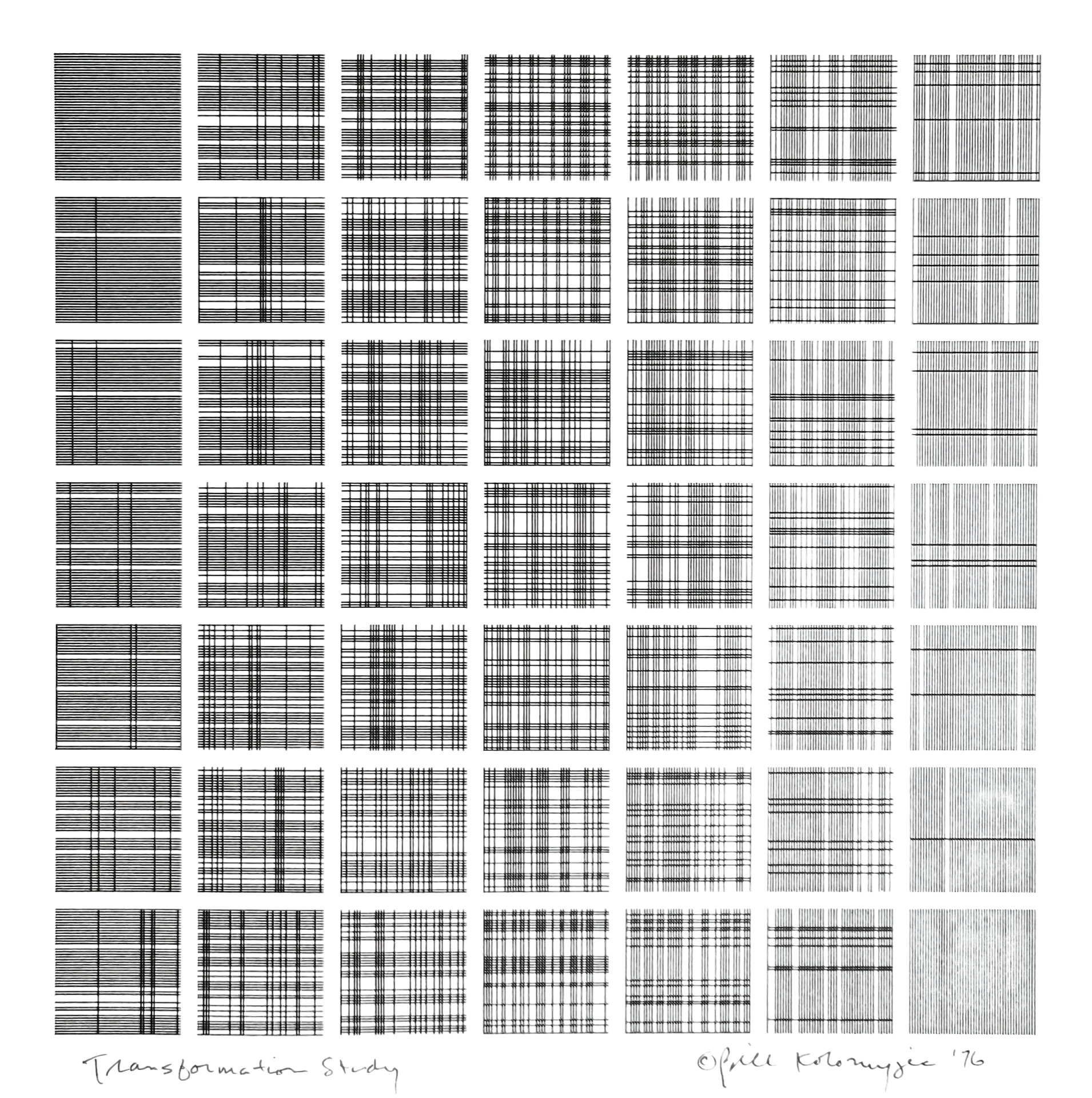
This was a proof of concept drawing of an algorithm I created for changing one image into another where I stored all the line segments that make up an image (in this case a set of vertical and horizontal lines) into two arrays. Think of it as of two bags of line segments.
Then, over the course of some number of frames (numFrames) I juxtapose one image on the other. For one frame I build one image, randomly picking out a percentage of the line segments (1/ numFrames). Then I overdraw the second image, complete at first by in subsequent frames subtracting some number of line segments.
For example, for an 11-frame sequence: First frame 100% of image one, 0% image 2. Second frame 90% of image 1, 10% of image 2. Third frame 80% of image 1, 20% of image 2. Until frame 11, 0% of image one, 100% image 2.
I used this algorithm as the basis for my work entitled: That Walleye Has Got a Lotta Gull.